Find out if your music will be turned down by YouTube, Spotify, TIDAL, Apple Music and more. Discover your music's Loudness Penalty score, for free.

Drag and drop an audio file here

Choose an audio file

MP3 or WAV

select a file

Your file will not be uploaded, stored or shared, meaning this process is secure and anonymous.

Online streaming services are turning down loud songs.

We all hate sudden changes in loudness - they're the #1 source of user complaints.

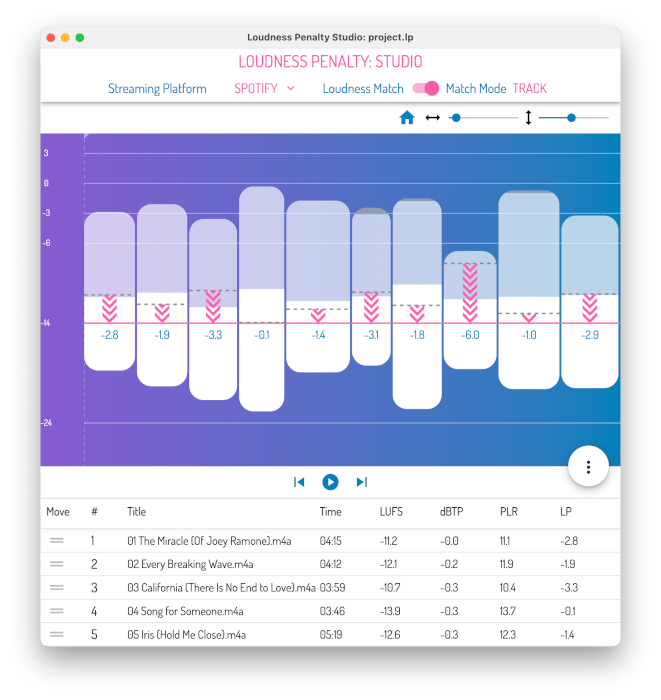
To avoid this and save us from being "blasted" unexpectedly, online streaming services measure loudness, and turn down music recorded at higher levels. We call this reduction the "Loudness Penalty" - the higher the level your music is mastered at, the bigger the penalty could be. But all the streaming services achieve this in different ways, and give different values, which makes it really hard to know how big the Loudness Penalty will be for your music...

Until now.

Simply select any WAV, MP3 or AAC file above, and within seconds we'll provide you with an accurate measurement of the Loudness Penalty for your music on many of the most popular music streaming services, and allow you to preview how it will sound for easy comparison with your favorite reference material.

Your file will not be uploaded, meaning this process is secure and anonymous.

Do you have any questions? Get in touch.
Processing audio

(but NOT uploading)

RESULTS (in dB)

0 YouTube
0 Spotify
0 TIDAL
0 Apple
0 Apple (Legacy)
0 Amazon
0 Pandora
0 Deezer

Want to take control of the Loudness Penalty for your music?

Find out how to optimize your music for impactful, punchy playback (and maximum encode quality) for all the online streaming services. Plus, receive a Loudness Penalty Report for your file that explains in detail what all the numbers mean.

Analyze another file

We just sent you an email with your report!

Analyze another file Visit MeterPlugs.com

Site%3afacebook.com+communityamericacreditunion+leak Better Link

: Social media platforms like Facebook often become hubs for community discussion, including topics related to data security and privacy. If a leak has occurred, members might discuss their concerns, share information, and seek advice from the community.

In reality, bad actors do not need an active database breach to execute this scam. They use automated dialing software to target phone numbers belonging to specific regional zip codes where CommunityAmerica has a dominant market share. Statistically, a large percentage of those text recipients will be credit union members, making the attack look precisely targeted. The Mechanics of the Spoofing and Phishing Attacks site%3afacebook.com+communityamericacreditunion+leak

The Anatomy of Financial Phishing: Dissecting the Fake "CommunityAmerica Credit Union Leak" Rumors on Facebook : Social media platforms like Facebook often become

If there's been a reported leak involving America Credit Union and it's being discussed on Facebook, here are some points that might be of interest: They use automated dialing software to target phone

: Users are increasingly concerned about their online security and privacy. Discussions might revolve around best practices for protecting personal information online and how to stay informed about potential breaches.

Scroll down to learn more about "Loudness Penalty"
Scroll down to learn what these numbers mean