14-Day Returns* · 2-Year Warranty · Worldwide Shipping, US Included
14-Day Returns*
2-Year Warranty
Worldwide Shipping, US Included
The "pound key"—that humble symbol (#) known variously as the hash, the number sign, or the octothorpe—serves as the silent gatekeeper of modern personal finance. While it appears as a simple grid of four lines, its role in debit card transactions represents the critical bridge between physical plastic and the digital movement of wealth. In the ecosystem of a debit transaction, the pound key acts as the "finalizer." When a consumer swipes or inserts their card at a Point of Sale (POS) terminal, they are prompted to enter a Personal Identification Number (PIN). The pound key serves as the definitive signal to the machine that the data entry is complete. By pressing #, the user shifts the process from local input to global verification. It is the digital equivalent of an "Enter" key, providing a tactile conclusion to a security protocol that keeps millions of bank accounts safe from unauthorized access. Beyond the checkout counter, the pound key is the primary navigator of the automated banking world. When calling a financial institution to activate a new card or check a balance, the # key is the most frequent command used to confirm account numbers or bypass lengthy instructional menus. In this context, it functions as a tool for efficiency, allowing users to navigate complex telephonic branches of their bank with a single tap. However, the pound key also marks a significant divide in payment processing: the choice between "Debit" and "Credit." When a terminal asks for a PIN (followed by the pound key), the transaction typically travels through an Electronic Funds Transfer (EFT) network, like Star or Pulse, deducting money almost instantly. If a user bypasses the PIN and the pound key—often by hitting "Cancel" or "Enter" without a code—the transaction is processed through a credit network like Visa or Mastercard. Thus, the pound key is not just a button; it is a selector of financial infrastructure. In conclusion, while the pound key might seem like a relic of the rotary-dial era, it remains indispensable to the debit card experience. It is the symbol of confirmation, the guardian of the PIN, and the mechanical pulse that completes the circuit of modern commerce. Would you like to explore the
The debit card is often reduced to a piece of plastic in a wallet, but its functionality is defined by the input methods we use to unlock its value. The "pound key debit card" is not just a piece of hardware; it is a ritual. pound key debit card
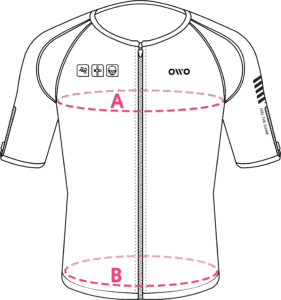
Measure your chest (A) and hips (B) following our indications.
The reference measurement will always be the larger of the two (A or B).
Look in the chart to which size corresponds to that measurement.
| Size | Reference measurements | |
|---|---|---|
| Inches | Centimeters | |
| 2XS | 25.6 – 29.4 | 65 – 74 |
| XS | 29.5 – 32.6 | 75 – 82 |
| S | 32.7 – 36.1 | 83 – 91 |
| M | 36.2 – 39.7 | 92 – 100 |
| L | 39.8 – 42.8 | 101 – 108 |
| XL | 42.9 – 46.3 | 109 – 117 |
| 2XL | 46.4 – 49.9 | 118 – 126 |
| 3XL | 50 – 53 | 127 – 134 |
| 4XL | 53.1 – 55.9 | 135 – 142 |